I grew up in a Christian context, going to church every week from as young as I can remember. When we were moving house one time, I was four years old and I prayed for a garden the size of a football pitch.
This became a source of amusement for the family, a story told for years to come, especially because we ended up moving to a house just across the road from a park, a grassy field big enough to house a football pitch.
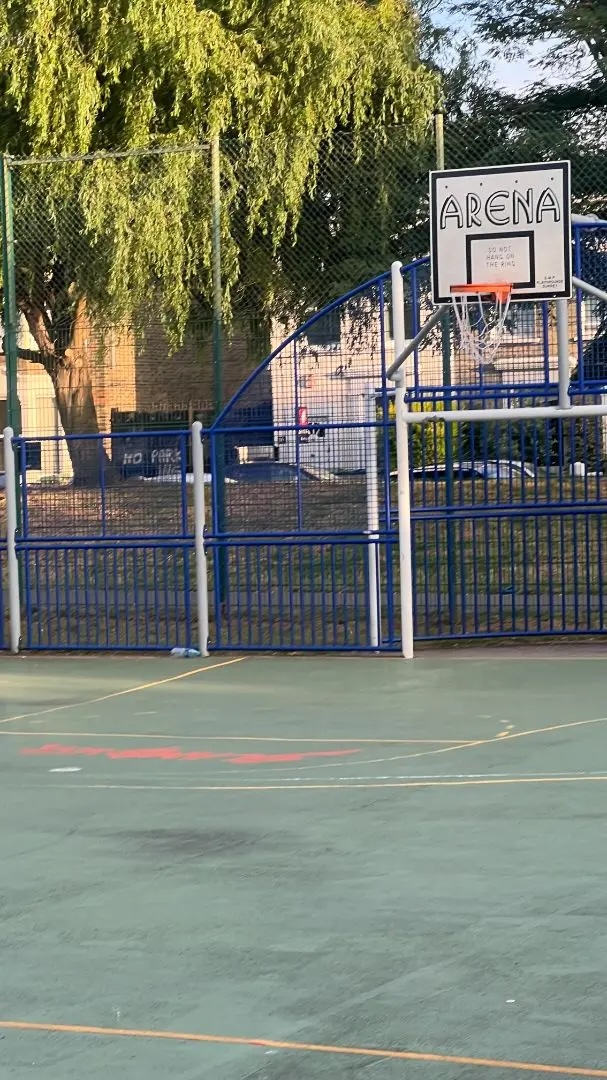
We called it the green. It started off as just grass, then–as I remember–it became home to goal posts and a playground. It gained a sign, naming it Dr Harold Moody Park (referencing a rich strand of history, one serious Jamaican doctor who opened a practice in Peckham in 1913). The muddy football pitch gave way to a brightly painted concrete-base cage with basketball hoops above the goals.
I cannot thank God enough for answering my childhood prayer with a that’s cool, but how about this. Instead of being granted a wish for a large, privately owned and enclosed space that would have been under the domain of the owners (my parents), me and my brothers were blessed with proximity to a common place designed for movement. Instead of restricted admission to the sacred sporting arena in a private garden, you could step from pavement onto park with no fence, no opening hours. On paper it was owned by the council I imagine. In reality it belonged to the community (as Amahra Spence writes, “Communities create value. Developers capture it.”).
People mixed and connected there without an entrance fee. It shaped me – it was one of multiple environments beyond the home and the nuclear family that formed me as a human being. There is an element of danger posed by places like this, a wildness and lack of domestication. Complexity and deep interconnectedness of communal places can sometimes give way to chaos, but they will rarely sink into order.
And order doesn’t grow us, nurture us or challenge us. Neuroplasticity is the brain’s ability to adapt and change in response to environments through experience. Too ordered, too boring, too controlled and we have nothing to learn. We adapt to those things, those environments, but often to our detriment. Order is death.
Cities have become the default home to humans. Empirical evidence in scientific approaches is revealing what bell hooks and many others have already noticed: that race, class, status, money thrive in the built environment. In Belonging: A Culture of Place, hooks describes her return from city life to rural Kentucky, describing the healing power of oneness with nature and reconnection with the land and her agrarian roots. Cities submit to the logics of empire, because they are, essentially, a project of empire. Fortresses against outsiders, centralising labour and food, and disconnecting them from local communities.
But we might be stuck with cities. So how do we design for community, for relational life – with people, but also place, plants and other creatures? How do we inhabit and shape the urban in ways to still hear creation?
We know that creation is the oldest,
voice of God in the Land,
a voice we are privileged to hear,
when we read the Landscape.
Aunty Denise in The Colonial Worldview of the Book of Joshua by Pattel-Gray and Habel (p. 16).
I want to grasp, to sense, how the environments we are shaping are in turn shaping us. M.R. O’Connor in Ignition, cites anthropologist Omer Stewart who “argued that scientists have made the grave mistake of assuming that their observations and studies were of “Nature,” when in fact they were of places where people and nature had interacted with one another for eons.” We make the same mistake studying biology too, forgetting we are in fact studying people where places and people have been interacting for eons.
Plasticity, unlike elasticity where each entity returns to its initial state after an interaction, says that interactions mould and shape the things that are doing the interacting. Urban plasticity brings this idea to the city. It was born from interdisciplinary academic work combining urban resilience and neuroplasticity research. It describes how the character of a city emerges from interactions of people and place. What happens to our planning and our designing when we keep returning to the question at the heart of this concept: how are people and place mutually shaping one another?
It’s funny how a love of sport and movement eventually led me to the brain as a subject of interest – how the nervous system changes and how we learn and perform movements. And now I’ve found myself back in that open field with two sets of goal posts wondering how design is being used to keep us apart and how it is, or can be, used to bring us together.

Leave a comment