In other words: show me how you are running, and I can see something of the society in which you are living.
Bale & Philo, p. 163, Body Cultures: Essays on Sport, Space and Identity by Henning Eichberg
Movement is an inevitability in a living world, a behaviour that reveals an interaction between things; it is an interaction between things.
To study human movement is to study people’s interactions with environments at an often intimate level. Movement depends on perception as much as the other way round. I’ve put forward this argument in more detail elsewhere, but movement – surprise, surprise – is not robotically controlled by programmes in the brain immune from the body’s surroundings. Change your sensory environment and movement can be remarkably changed too, such as drawing lines on the floor to restore smooth walking for someone with Parkinson’s.
A particularly interesting trail of studies emerged when researchers decided to measure the variability in walking behaviour, rather than consider it as noise and filter it out. Finding patterns in the noise, specifically the variability of stepping intervals (the time between each step), turned out to be insightful to what was happening in the nervous system. Patterns tended to be really variable, with no identifiable patterns, in instances of nervous system damage in older age or illness. Variability of stepping intervals predicts the volume of a few brain areas, responds to deep brain stimulation, and tends to be elevated in neurodegenerative conditions like Parkinson’s, Huntington’s and dementia. But stepping intervals have never been found to be perfectly equal, ordered.
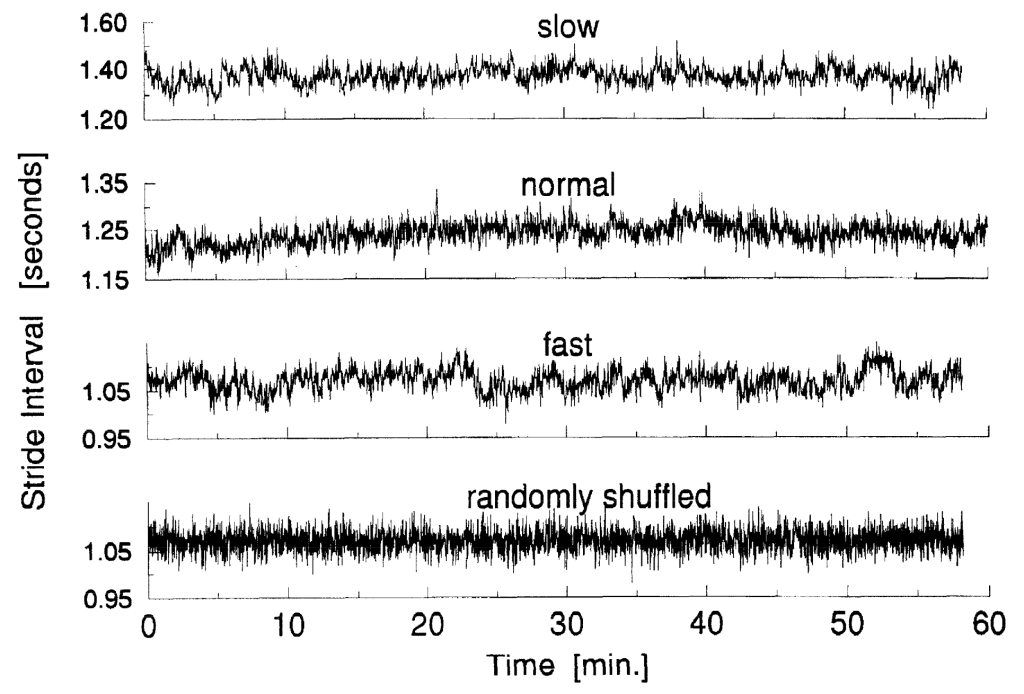
From Hausdorff et al. (1996). Walking patterns might look a little random to begin with but when you compare them to the same data which has actually been randomly shuffled (bottom panel), you can see shapes in the data.
As Tim Ingold discusses in The Perception of the Environment, neuroscientist Nicholai Bernstein noticed this phenomenon of variability when observing a skilled blacksmith repeatedly hammering iron on an anvil. The trajectory of the hammer tip was highly consistent, but the arm movement was variable – unexpected when an expert’s skill is considered as accurate, precise and even under control.
A similar phenomenon has been noted in the long jump: there is a large amount of variability in distance between the toe and take-off board in the middle of the run up, but this sharply declines the closer to the board an athlete gets. That is, the last few steps are very consistent trial-to-trial but the earlier steps are often highly variable. Bernstein argued that the skill is not in reproducing identical movements each trial, but in tuning the movements in real-time to the task’s needs and responding to changes in the environment.
Complexity science studies systems that contain multiple, interconnected parts which therefore give rise to unpredictable and non-linear behaviours. People, as well as cities and many other things have been studied as complex systems. Variable gait is just one behaviour demonstrating the non-linearity of movement by a complex system that exists at the edge of chaos. An organism living in a state of perfect equilibrium is not alive, but dead; instead we are forever in an unfolding state, forming new memories by sharing memories with those (people, places) we connect with.
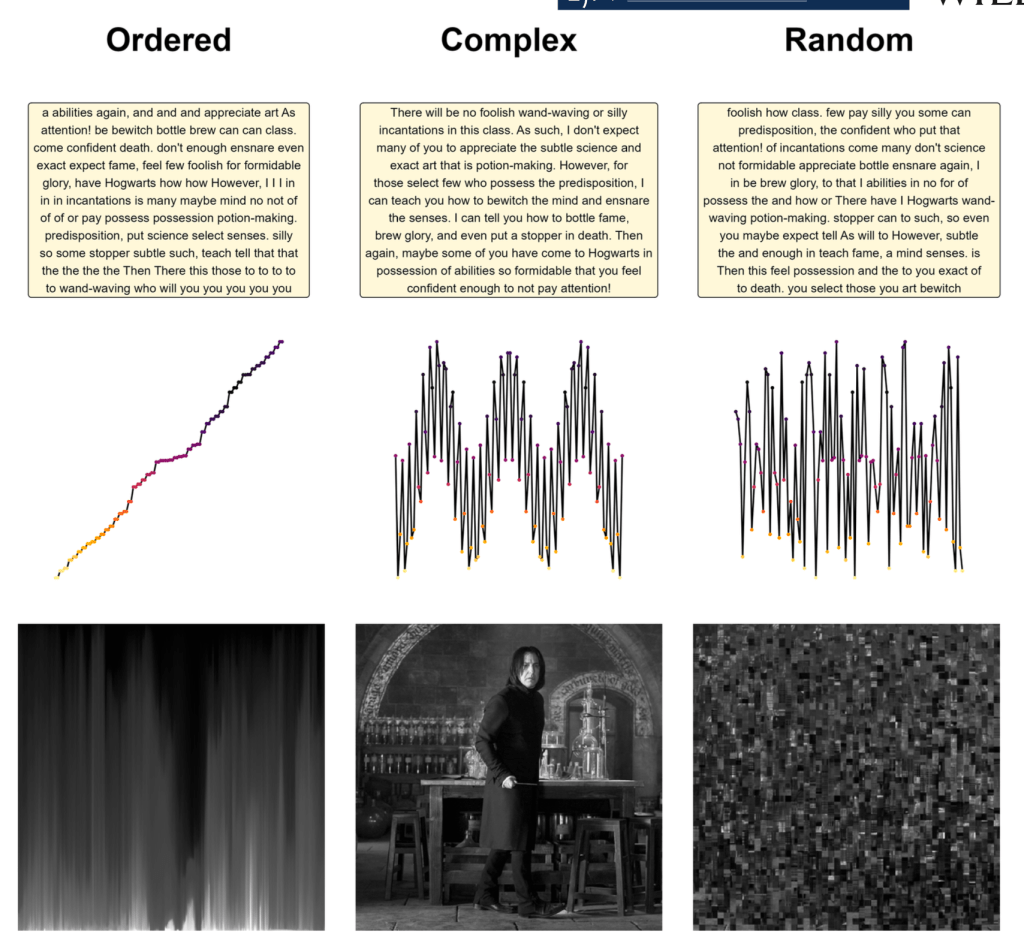
From Lau et al (2022). An illustration of ordered, complex and random data. In the top row, words are first arranged alphabetically (ordered), according to semantic and syntactic rules (complex) and then randomly. The middle row is just an arbitrary signal, firstly ordered by amplitude, then as a combination of different frequencies (complex), and then randomly. The final row sees pixels in an image (centre) ordered by luminance on the left and then randomly shuffled on the right. Conveying meaning is thus a characteristic of complex information.
So, back to the opening proposal: how are we moving and what does that tell us about people-place conglomerations in an urban world? I have started to use phone-based accelerometry to observe how we move in different places. I believe this might help us notice how places are shaping us through their invitations to move in particular ways and restrictions to not move in other ways. There are interesting endeavours pushing complexity as a metric to be maximised in design. Doing so makes some sense when we have been building highly disciplined, insulated environments that render movement simple without challenging us, without cultivating intrigue, nor requiring intimate sensory interactions with wind, soil, water, plants and other creatures.
Perhaps complexity metrics are a useful development in moving beyond narrow definitions of beauty in architecture and resisting motivating factors such as profit and convenience in design. As well as highlighting a world of fractals and inseparability (resisting the tide of atomisation in science), the great realisation of complexity theory is that that life cannot be predicted. Can we ever quantify our way to thriving, living communion with peoples and place? Only if that quantification is just the start of a journey into deeper sensing, a journey that takes us to places that give life rather than drain it.
As Tess Osborne writes in her recent article on nostalgia as a biosocial memory process that attaches body to place, “physiological signals might, when read in context, offer insights into the ways people experience and express attachment and loss.” Instead of “treating biosensing data as objective indicators of internal states”, physiological signals can “enrich our understanding of the affective intensity and spatial texture of memory”.
We are living in a modern world created by the great divide between humans and land. Willie James Jennings, in Christian Imagination: Theology and the Origins of Race details this divide, the commodification of people and land and the mutual loss lying in its wake. The problems that arise in the world are more often than not pursued with technological solutions that take us further into the trap of living apart from sources of life. Research aimed at combatting global crises at a local level needs to teach us to sense this loss and be able to recognise alternative futures being lived out in the present day (as Hazel Sheffield explores in her book, Frontierlands).
I close with some questions I’m chewing while preparing to begin walking interviews to understanding how people experience the design of affordable housing.
- How do we design places to make our movements more responsive and able to attune to environments – how do we design for attachment?
- People’s capacities vary so how do we design to make movement more possible when it has been impossible and more challenging when we are stagnating?
- Even if cities are still complex, many terrains we navigate are much more ordered and disciplined than the environments cities replaced – think of walking in the woods compared to going up an escalator in a shopping mall. Considering that through plastic processes we adapt to such environments, can we even handle more complexity?
- And how have we used land in ways that have harmed our movement ability (and therefore health)?
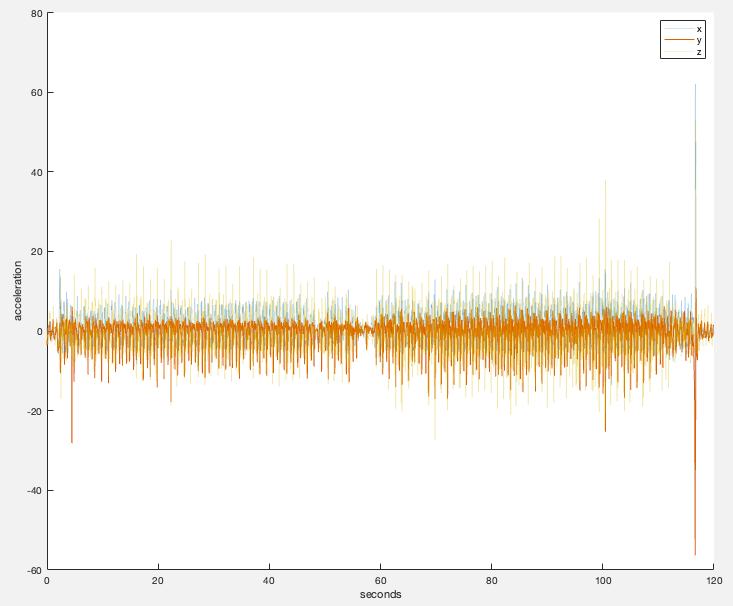
Two minutes of me walking (while carrying little man). The longitudinal axis of the phone is y, with x and z axes in a paler blue and yellow behind. This is inertial data from which heel strike can be identified and then interval duration calculated. Collected using a brilliant app called PhysicsToolbox.

Leave a comment